
How to Completely Remove Stubborn Industrial Deposits? A Practical Guide to Using Hydrochloric Acid in Industries.
Introduction
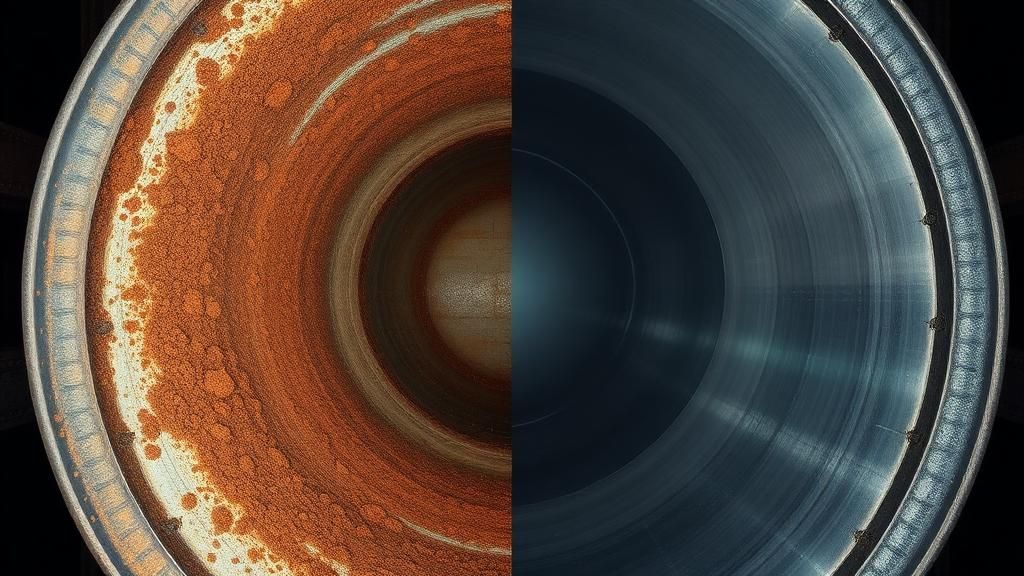
Industrial deposits are the silent cholesterol in your factory’s arteries. They quietly build up on the walls of boilers, heat exchangers, and pipes, devouring heat transfer efficiency, skyrocketing energy consumption, and finally, bringing the production line to its knees with a costly shutdown. Combating these stubborn deposits is a precise chemical battle, not a blind war. Hydrochloric acid (HCl) is your most powerful weapon in this battle, but using it requires precise technical knowledge. This article is your practical guide and roadmap for the precise surgery of these deposits and restoring life to your equipment.
Know Your Enemy: What is the Anatomy of Scale?
Before choosing your weapon, you must know the enemy. “Scale” is a general term, but in reality, these deposits are a complex mixture of minerals. The most common is “calcium carbonate” (CaCO₃), which precipitates from hard water in boilers and cooling towers. Alongside it, there are iron oxides (rust), silicates, and sometimes sulfates. Each of these has a different chemical lock. The good news is that hydrochloric acid, as a strong acid, is the master key that reacts quickly and completely, specifically with calcium carbonate—the hardest and most common type of scale—turning it into a water-soluble salt.
Why HCl? Choosing the Right Surgeon for This Operation
Why is hydrochloric acid (HCl) the first choice of professionals for descaling among all acids? The answer lies in its “power” and “dissolution speed.” HCl breaks down carbonate scale at a very high speed, converting it into calcium chloride (which is completely water-soluble), water, and CO₂ gas. This complete solubility is vital; unlike sulfuric acid, which can react with calcium and create “calcium sulfate” (gypsum) scale—which is even harder than the original scale! HCl does the job once and completely, leaving no new solid residue behind. This is why it is considered the industrial standard for the “Acid Washing” process.
Corrosion Inhibitor: Your Metals’ Protective Shield
The biggest fear of technical managers during acid washing is: “Won’t the acid damage my pipes and equipment?” This is a completely valid fear. Raw hydrochloric acid does not differentiate between scale and metal. This is where the science of “corrosion inhibitors” comes in. These smart chemicals, which are added to the acid, act like a shield. They form a very thin molecular layer on the surface of the healthy metal (like steel) and prevent the acid from contacting it, while allowing the acid to freely attack the scale (which has no coating). Acid washing without an inhibitor is an unacceptable risk; acid washing with an inhibitor is an engineered and safe process.
Step-by-Step Acid Washing Protocol (Practical Guide)
A successful descaling operation requires a precise protocol. First, the system (e.g., a boiler) must be isolated and flushed with water to remove loose deposits. Then, the diluted (usually 5% to 10%) and “inhibited” hydrochloric acid solution is slowly circulated through the system. The temperature must be carefully controlled, as excessive heat reduces the inhibitor’s effectiveness. During the process, the acid’s strength must be measured with special kits; when the acid concentration remains constant, it means all the scale has been consumed. Finally, the system must be completely drained, flushed with water, and then “neutralized” with a weak alkaline solution (like soda ash) to ensure no residual acid remains in the system.
Why is the “Purity” of Mihan Zaj’s Hydrochloric Acid Vital?
In a precise chemical process like acid washing, you cannot work with unknown variables. What happens if your hydrochloric acid contains impurities like excess iron or heavy metals? These impurities can interfere with the process, react with your inhibitor, or even worse, create new stains (like iron staining) on the cleaned surface. Furthermore, the exact concentration of the acid is critical for calculating the dilution ratio and the amount of inhibitor needed. Mihan Zaj’s hydrochloric acid, with its guaranteed purity and stable concentration, gives you the confidence that your acid washing protocol will proceed exactly according to calculations and yield a predictable, safe, and complete result. We don’t just sell the raw material; we deliver “confidence.”